

It's 7:40 pm. The Class 12 physics batch is halfway through rotational motion when the owner's phone lights up again — a parent asking "fees kitni hai?" (what are the fees?). He will call back after class. By then she has spoken to two other institutes, because the lead portal that sold him her number sold it to them too. I'll call him Rakesh — a composite of the coaching owners we have spoken to around Bokaro, not a client — and his problem is why I am writing this guide to a website for coaching institutes in India. His admissions are not lost in the classroom. They are lost between the enquiry and the answer.
Yes — a coaching institute in India needs a website in 2026: one that publishes fees, the refund and exit policy, each tutor's qualifications and honest year-wise results (the disclosure list in the Ministry of Education's 2024 model guidelines, now written into Jharkhand's and Rajasthan's coaching Acts), captures every enquiry on WhatsApp or a short form, and costs ₹15,000 to ₹40,000 for most institutes, live in 3 days to 2 weeks. Full disclosure: we build these sites ourselves at Webknown, an 8-person agency in Bokaro Steel City, so read the cost section knowing that.
In short
- Publish: fees, refund and exit policy, tutors' qualifications, courses and duration, hostel details if any, and year-wise results — with written consent for every student you name.
- Cost: ₹15,000 (5-page Starter) to ₹40,000 (15-page Professional); from ₹1,00,000 only for logins, fee payment or a test portal. Domain and hosting extra, roughly ₹4,000–₹10,000 a year.
- Time: 3–7 days for Starter, 1–2 weeks for Professional.
Your Admission Season Leaks Between the Enquiry and the Answer
Most institutes do not have an enquiry problem. They have an enquiry-handling problem, and it costs more every season than a website costs once.
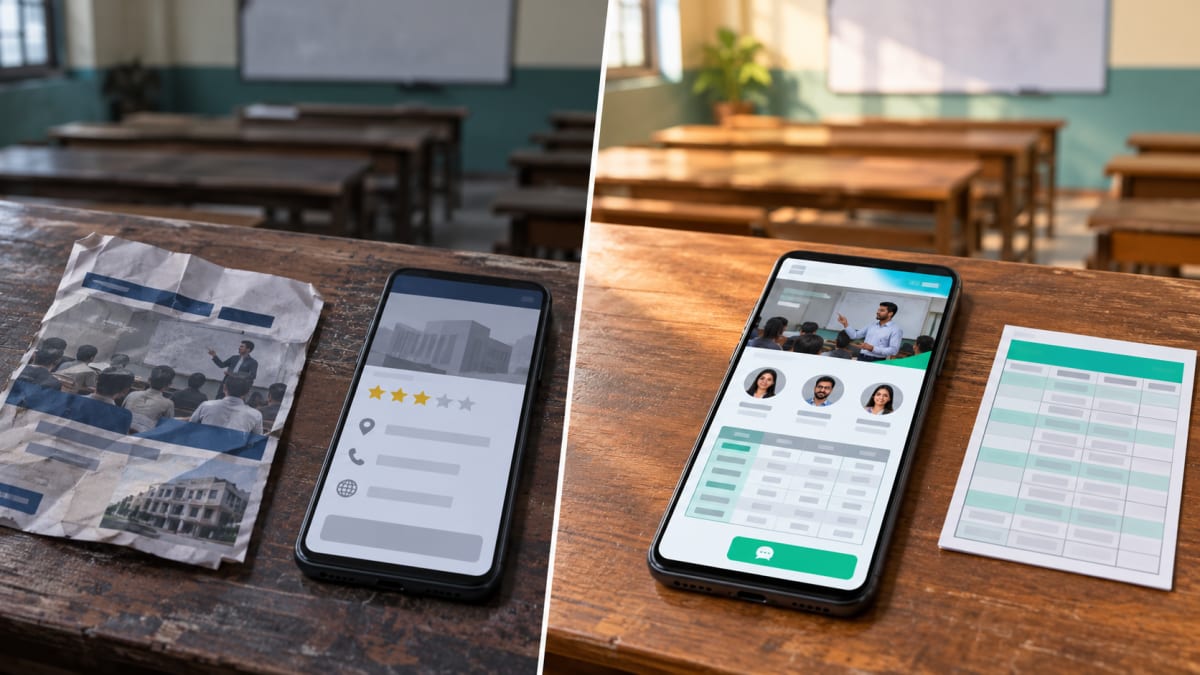
Let me walk you through where Rakesh's enquiries go. The pamphlet has a phone number and nothing else, so every parent calls — during class. The portal "lead" is a number sold to several institutes in the same pin code. WhatsApp sits unread until the last batch leaves. And "result kya raha pichle saal?" (what was last year's result?) gets a different answer from every teacher.
She is online either way. India had about 958 million active internet users in 2025, nearly 57% of them rural (IAMAI–Kantar, Internet in India 2025, via Free Press Journal); mobile carries about 78% of India's web traffic (StatCounter, September 2026); and 27% of Indian students take or have taken private coaching (MoSPI survey 2025, via PTI/The Week). She searches your institute's name that evening, and a three-star listing with no fees is where the enquiry leaks.
One leaked enquiry, in rupees
Worked example — Rakesh's JEE and NEET centre (assumptions, not a forecast):
- 240 enquiries across the April–July season; 1 in 4 becomes an admission — 60 admissions.
- Average annual fee ₹36,000. Season revenue: 60 × ₹36,000 = ₹21,60,000 (₹21.6 lakh). One enquiry is worth ₹21,60,000 ÷ 240 = ₹9,000.
- The leak: if 1 in 5 phone and WhatsApp enquiries goes cold because the reply came after class, that is 48 enquiries, 12 admissions and ₹4,32,000 (₹4.32 lakh) to whoever answered first.
- The fix, priced: a Professional site from ₹40,000 plus ₹4,000–₹10,000 a year for hosting; recovering two of those twelve admissions pays for it.
The rates are mine, not a study — swap in your own. The site does not create enquiries; it stops them leaking. A website for coaching institutes in India is not a brochure. It is the one place that answers "fees kitni hai?" at 7:40 pm without a teacher leaving the board.
The 2024 Guidelines Quietly Turned Your Website Into a Notice Board
The Ministry of Education's 2024 guidelines list what a coaching centre's website must display, and two states have now made that list law. Whether it binds you yet depends on your state.
On 16 January 2024 the Ministry sent every State and UT its "Guidelines for Regulation of Coaching Center"; education is on the Concurrent List, so States must give them force through their own Acts or rules (Rajya Sabha Unstarred Question 983, 31 July 2024). The clause people search for as the coaching centre website guidelines 2024 says the centre "shall have a website with updated details of the qualification of tutors, courses/curriculum, duration of completion, hostel facilities (if any), and the fees being charged, easy exit policy, fee refund policy, number of students undertaken coaching from the centre and number of students finally succeeded in getting admission in Higher Education Institutions" (Business Today, 19 January 2024). Model penalties: ₹25,000, then ₹1,00,000, then revocation of registration (LexCounsel via Legal500, 8 February 2024).
Haryana and Bihar already had coaching Acts; after a Supreme Court order of 25 July 2025 (SCC Online), five more States and UTs notified rules in 2026 (Puducherry Gazette, 17 February 2026). Two matter most here:
- Jharkhand — our state. The Coaching Centre (Control and Regulation) Act, 2025 has been in force since 2 March 2026 for centres with more than 50 students. Section 13(7)(j) copies the website list word for word; s.13(7)(d) adds the timetable "on their website and/or notice board"; s.17(1) wants every policy on the website and an annual report within three months of year-end; s.18 requires compliance with the CCPA advertising guidelines below. Penalties: up to ₹5,00,000, then ₹10,00,000, then cancellation (Jharkhand Act 01 of 2026, PRS copy).
- Rajasthan. The 2025 Act (assented 23 September 2025) has the same list in s.8(3) for centres above 100 students and penalties of ₹50,000, then ₹2,00,000, then cancellation; it still awaits a commencement notification (Rajasthan Act 16 of 2025, PRS copy).
This is not legal advice — check your state's Act or rules and talk to a lawyer before you publish.
The mandatory-disclosures checklist
| What the 2024 guidelines say must be published | Which page | What to write |
|---|---|---|
| Qualification of tutors | Faculty | Degree, university, subject, years taught — graduation is the minimum (PTI via The Tribune) |
| Courses / curriculum and duration | Courses | Exam, syllabus outline, start and end month, hours a week, batch size |
| Fees being charged | Fees | Fee per course, instalments, inclusions; a receipt for every payment; no increase during the course (Rajya Sabha answer) |
| Easy exit and fee refund policy | Fees, or a Policies page | "Leave mid-course: pro-rata refund of the remaining period within 10 days, hostel and mess fees included" (Business Today) |
| Hostel facilities (if any) | Hostel, or one line on Courses | Rooms, mess, fee, refund rule — or "no hostel" |
| Number who took coaching; number admitted to higher-education institutions | Results | Year-wise: enrolled, appeared, admitted; course each named student took; consent on file |
| Jharkhand add-ons: timetable, all policies, annual report | Timetable; Policies; About | An editable timetable; one Policies page; the annual report as a dated PDF |
Not sure what your state has adopted, or which pages you are missing? Bring your pamphlet and fee sheet — we check them against this list, or tell you a website isn't your bottleneck yet.
Book a Free 20-Minute CallCan Your Topper Poster Get You Fined? The CCPA Rules in Plain Words
Yes — if it names a student without written consent taken after the result, or counts "selections" who only took a free programme. The regulator has fined institutes for both.
The CCPA coaching advertisement guidelines — formally the Guidelines for Prevention of Misleading Advertisement in Coaching Sector, 2024 — took effect on 13 November 2024 and cover "all forms of advertisements by any person including an endorser engaged in coaching sector" (CCPA notification; PIB, 13 November 2024). Your website counts: in its Vision IAS order the CCPA wrote that "unlike print media, a website is accessible globally and remains available for an extended period" (PIB, 25 December 2025). A breach can cost up to ₹10 lakh, and ₹50 lakh for every subsequent one, under section 21(2) of the Consumer Protection Act, 2019 (text). By 30 May 2026 the CCPA had issued more than 60 notices to coaching institutes and imposed penalties exceeding ₹1.46 crore (PIB, 30 May 2026).
Two examples, in the regulator's own framing:
- The CCPA imposed ₹7 lakh on Vajirao & Reddy Institute for claiming "617 selections out of 933 in UPSC CSE 2022" when all 617 had taken only its free Interview Guidance Programme (PIB, 26 December 2024), then ₹15 lakh in February 2026 for similar CSE 2023 claims as a subsequent contravention (PIB, 23 February 2026).
- The CCPA imposed ₹10 lakh on Motion Education and ₹5 lakh on Career Line Coaching, Sikar, in May 2026, finding among other things that neither could show written consent taken from successful candidates after the results; both have appealed (PIB, 15 May 2026).
The clauses are identical for a 60-student centre in Bokaro.
Safe and unsafe wording for results pages, posters and ads
| Unsafe claim | Why it is a problem | Safe alternative |
|---|---|---|
| "Selection pakka" / "100% selection" / "rank under 1,000 guaranteed" | Clause 3(c): no guaranteed selection, rank or marks — the CCPA's ₹7 lakh order against StudyIQ IAS cited its "Selection Pakka Offer" ads | "2025 JEE batch: 48 enrolled, 11 qualified for JEE Advanced (one-year paid course)" — the full list on the results page |
| "200+ selections" over a collage of faces | Clause 3(b): no false selection counts; clause 4(1)(a): each photo needs the rank, course name and duration, and whether it was paid | "Priya S., AIR 1,204, two-year classroom course (paid), 2024–26" |
| A topper's photo lifted from the result PDF | Clause 4(2): no name, photo, testimonial or video without written consent taken after the selection | A signed, dated consent form after results, filed with the enrolment record; publish only those students |
| "Only 5 seats left" when 40 are open | Clause 3(e): false urgency or scarcity | "Batch of 40 starts 7 April; admissions close when it fills" |
| "100% refund*" with a tiny asterisk | Clause 4(1)(b): disclaimers in the same font as the claim | The refund rule in full, in the same size as the offer |
Posters and topper creatives are where most slips happen, so any admission poster or topper creative we design starts with the consent file and the rank-course-paid line in the layout. Admission-season Google and Meta ads need the same disclosures — that is how we run local SEO, Google Business Profile and CCPA-compliant ad campaigns; nobody can honestly guarantee a ranking, and under ₹25,000 a month of total marketing budget, do your own social media and fund the website first. For the same regulator-first logic applied to clinics, see our guide to websites for doctors under the NMC rules.
What a Website for Coaching Institutes in India Needs Beyond the Legal List
The legal list gives a parent facts. Three more things make her message you tonight — and turn a coaching institute website for admissions into the one your office actually uses.
Enquiry capture that works at 10 pm
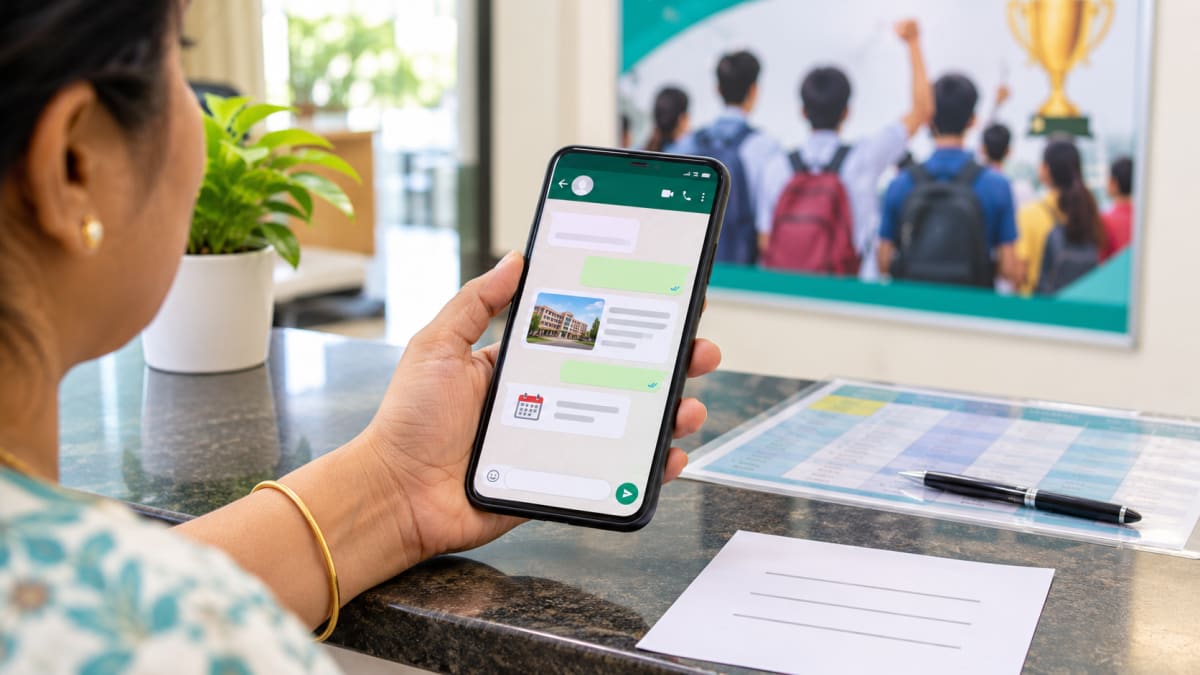
A WhatsApp button on every page, pre-filled with the course name, plus a three-field form — student name, class, target exam, parent's number. Add a parental-consent field for students under 16 or yet to pass matriculation; the Jharkhand Act requires a parent's explicit written consent before enrolling them (Jharkhand Act, s.13(8)). An auto-reply sends the fee page, the timetable and the next demo date — "demo class kab hai?" (when is the demo class?) is the second question after fees, and a machine answers it in four seconds. Everything lands in an enquiry dashboard your office sees next morning. Most of the nine UX mistakes that lose enquiries I wrote about are enquiry-capture mistakes.
A timetable, faculty clips and Hindi
Class, subject, days, time, start date, updated when it changes — the Jharkhand Act expects it on the website and/or notice board, and every parent wants it. A degree line satisfies the faculty rule; a 30-second clip of a teacher solving one problem builds trust no adjective can — we cut teacher demo reels and classroom walkthroughs from ₹5,000 a video. Add a Hindi toggle where parents read Hindi, and keep every page under two seconds — our builds average under that.
Copy that would survive a notice
The fee, refund, faculty and results pages are the compliance — the writing is the product. If drafting them to the two tables above is the part you dread, our content writing team writes them in 5–10 days, and they double as your prospectus text.
What Does a Coaching Institute Website Cost in 2026?
Most institutes land between ₹15,000 and ₹40,000; you cross ₹1,00,000 only for student logins, online fee payment or a test portal. The coaching institute website design cost depends on page count and add-ons. Real starting prices from our web development page — the written quote confirms the final figure before any work starts:
| Plan | Pages | Timeline | Starting price | What's included |
|---|---|---|---|---|
| Starter | Up to 5 | 3–7 days | ₹15,000 | WordPress or Wix Studio; Home, Courses & Fees, Faculty, Results, Contact; WhatsApp button, enquiry form; 3 revision rounds; 30 days free support |
| Professional (most popular) | Up to 15 | 1–2 weeks | ₹40,000 | WordPress, Wix Studio or Next.js; Fees, Refund & Exit, Hostel, Timetable and per-course pages; full SEO, analytics, blog; 3 revision rounds; 30 days support |
| Custom | As needed | 2–6 weeks | ₹1,00,000 | Next.js/React/Node.js; student logins, online fee payment, test portal, enquiry dashboard; 3 revision rounds; 30 days support |
Domain and hosting are separate yearly fees paid to those providers. Our website cost calculator puts domain, shared hosting and SSL at roughly ₹4,000–₹10,000 a year at providers' prices, and prices add-ons such as booking, a Hindi version or an enquiry dashboard — so a Professional site is about ₹50,000 in year one at the top of that range, then about ₹10,000 a year.

The price excludes local SEO and your Google Business Profile (setup in a week, results in 1–3 months, from ₹15,000 a month) and admission-season Google and Meta ads (ad spend separate, CCPA wording above).
Launch timeline: Starter in 3–7 days, Professional in 1–2 weeks
- Discovery — Day 1 / Days 1–2. A 20-minute call; you send the fee sheet, faculty degrees, year-wise results and signed consents; domain and hosting bought in your name.
- Content — Day 2 / Days 3–5. Fee, faculty, results and policy text written to the checklist; Professional adds per-course pages and Hindi.
- Build — Day 3 / Days 6–9. WordPress, Wix Studio or (Professional) Next.js; WhatsApp button and form wired to your number; Professional adds dashboard, analytics and blog.
- Review — Days 4–5 / Days 10–12. You check every fee and name on a phone; three revision rounds; wording checked against the safe/unsafe table; speed under two seconds.
- Launch — Days 6–7 / Days 13–14. SSL, Google Business Profile linked, submitted to Google; 30 days of free support begins.
We took Platform10X from zero to live in two days; what slows a build is never the code but the fee sheet nobody has written down.
FAQ: Coaching Institute Websites in India
Does a coaching institute in India legally need a website in 2026?
It depends on your state. The 16 January 2024 guidelines are model guidelines, not a central Act. Jharkhand's Act, in force since 2 March 2026, makes a website with the full disclosure list a registration undertaking for centres above 50 students; Rajasthan's 2025 Act has the same clause but awaits commencement. Elsewhere, check your state's rules and treat the list as the floor.
What must a coaching centre website show under the 2024 guidelines?
Nine things: tutors' qualifications, courses, duration, hostel facilities if any, fees, the exit policy, the refund policy, the number of students who took coaching from you, and the number admitted to higher-education institutions. Step one is a spreadsheet with those nine columns filled for every course; the website is that spreadsheet made readable on a phone.
How much does a website for coaching institutes in India cost?
Our published starting prices are ₹15,000 for a Starter site (up to 5 pages, 3–7 days), ₹40,000 for a Professional site (up to 15 pages, 1–2 weeks) and ₹1,00,000 for a custom build with logins or online fee payment (2–6 weeks). Domain, hosting and SSL add roughly ₹4,000–₹10,000 a year; the written quote confirms the figure.
Can I put my toppers' photos and ranks on the site?
Yes, on two conditions from the CCPA's 2024 guidelines: written consent from the student, taken after the selection rather than at enrolment, and — beside each photo — the rank secured, the course name and duration, and whether the course was paid. In May 2026 the CCPA penalised two institutes partly for lacking exactly that consent.
How quickly can the website be live before admission season?
A 5-page Starter goes live in 3–7 days and a 15-page Professional in 1–2 weeks from the day your material arrives. The slow part is yours: the fee sheet, each tutor's degree, three years of results and signed consent forms. Collect those in a week, start in early March, and you are live before April.
Will a website bring admissions on its own?
No, and nobody can honestly promise that. It converts the enquiries your pamphlets, Google Business Profile and word of mouth already generate — in the worked example above, recovering two of twelve lost admissions pays for it. Local SEO takes 1–3 months to show results, so a site launched in January is working by April; one launched in June mostly serves next year.
Before the Next Admission Season Opens, Fix the Leak
The institute that wins April is the one whose fee page answered the 7:40 pm question, whose results page would survive a CCPA notice, and whose WhatsApp replied in four seconds while the owner was at the board. A website for coaching institutes in India earns its fee the first season it stops the leak.
Book a free 20-minute discovery call at webknown.in/book or message us on WhatsApp at +91 82100 48512. We reply within 4 hours during business hours, Monday to Saturday, 10 AM to 10 PM IST — eight in-house specialists in Bokaro Steel City, zero outsourcing. Bring the fee sheet. And if a ₹15,000 Starter site is all you need, that is what we will tell you.
Twenty minutes on a call — bring your fee sheet, leave with a clear plan, timeline and exact cost.
Book a Free 20-Minute Call
Comments0