

Most CA firms in India run on referrals, and most partners will tell you that's all they need. Fair enough — referrals built your practice. But the referral itself has changed. When a client recommends you at a dinner or on a WhatsApp group, the next thing that person does is type your name into Google. What they find — or don't find — decides whether your phone rings.
So, does a CA firm in India actually need a website in 2026? Yes — not to advertise (ICAI's solicitation rules still apply), but because clients now verify a referred CA online before calling. A factual, compliant website is explicitly permitted under ICAI's Website Guidelines, and for a growing share of clients it's the difference between "let me call him" and "let me ask someone else." This guide covers the case for a website for CA firms in India, what ICAI allows, and what it really costs.
Your Next Client Googles You Before They Call You
Start with the numbers, because they're hard to argue with.
The sources, since a CA would rightly ask: ICAI's own 2025 membership data puts active members at 4,07,629. The IAMAI–Kantar ICUBE report says India crossed 900 million internet users in 2025. A Visual Objects consumer survey found 76% of people look up a business online before engaging it in person. And Google's India search data shows "near me" queries rose about 75% in a single year.
Put those together and the picture is simple. There are more CAs competing for the same clients than ever, and nearly every prospective client is online. When someone searches "CA for GST registration in Indore" or "chartered accountant near me", firms with a website show up. Firms without one don't exist in that moment — no matter how good their work is.
Referrals Don't Bring Clients Anymore. They Bring Searches.
Here's a scene every practising CA will recognise. A businessman asks his friend for a good CA. The friend says, "Call Sharma ji, he handles my books." Ten years ago, that was a done deal. Today the businessman Googles "Sharma and Associates CA" first. If he finds a clean website — qualifications, services, office address, a few useful articles on GST — the call happens. If he finds nothing, or worse, an abandoned Justdial listing with one angry review, he quietly asks someone else.
The referral still happened. You just lost it at the verification step. That's the real cost of not having a website: not missed strangers, but missed referrals you never knew about.

Is a Website for CA Firms in India Even Allowed? The ICAI Rules, Straight
This is where most CAs hesitate, and the caution is justified. Clauses (6) and (7) of Part I of the First Schedule to the Chartered Accountants Act, 1949 bar solicitation and advertisement. Violating them is professional misconduct, and ICAI's Disciplinary Directorate does act on it.
But ICAI settled this question long ago. The Council issued Website Guidelines in 2001, revised them in February 2020 (they sit in Volume II of the Code of Ethics), and issued a detailed advisory in October 2020 spelling out exactly what's prohibited. The Guidelines exist specifically so members and firms can run a website without hitting Clauses (6) and (7). A website is permitted. A website that solicits is not.
What Your Website Can Show
- Factual particulars: firm name, partner names and qualifications, year of establishment, office address, phone, email and social media handles.
- Services you provide: audit, taxation, GST, company law work — stated plainly, as facts, not pitches.
- Professional content: articles, professional updates and educational material. A well-written explainer on the new tax regime is fully compliant — and it's also your best trust signal.
- Passport-style photographs of partners.
What It Cannot Show
- Client names, client logos, or testimonials that name a client.
- Fees, or any mention of free services.
- Superlatives and subjective claims — "leading firm", "best CA in Delhi", "why choose us" sections.
- Awards, rankings, ISO certification mentions, media coverage, or empanelment details.
- Push-mode promotion of core professional services — the site must work on a "pull" basis, found by people looking for it.
Notice the pattern: ICAI bans persuasion, not presence. A factual website that informs is fine; one that sells is not. The catch is that most generic web designers don't know this list exists. They'll happily add a "Top CA Firm in Mumbai!" banner and a client-logo carousel — and hand you a disciplinary problem with a 30-day support plan. The copy on a CA website has to be written by someone who has actually read the Guidelines. That's a writing problem as much as a design one, which is why we treat content writing as a separate discipline, not an afterthought.
Every word on your site written to inform, rank — and stay on the right side of ICAI's Guidelines.
Get Compliant Website CopyWhat a CA Firm Website Actually Needs (It's Less Than You Think)
You don't need a 40-page site with animations. You need a fast, factual site that answers a prospect's three questions in under a minute: Who are you? What do you handle? How do I reach you?

The working structure for most firms:
- Home: firm name, one factual line about what you do, city, and a clear contact path.
- Services: a page (or section) per practice area — audit, direct tax, GST, ROC/company law. Plain descriptions, no adjectives.
- Partners: names, qualifications, membership numbers, passport-style photos.
- Articles: even one useful piece a month on tax deadlines or GST changes builds search visibility and shows clients you're current.
- Contact: address with a map, phone, email, and a working form. In 2026, a WhatsApp link matters more than a fax number ever did.
Two technical points that get ignored and shouldn't be. First, mobile: in India, over 80% of searches happen on phones, so a site that breaks on a small screen is a site that breaks for most visitors. Second, speed: if your site takes five seconds to load, a chunk of visitors leave before they see your name. Both are build-quality issues — they're decided by who develops your site, not by how much content you put on it. This is the core of what we do at Webknown's web development practice: fast, mobile-first, SEO-ready sites, most of them live within two weeks.
A fast, mobile-first firm website — built, tested and live in one to two weeks.
Get a Free Website QuoteWhat a Website for CA Firms in India Costs in 2026
Honest numbers, because vague "contact us for pricing" pages waste everyone's time. Here's what websites actually cost at Webknown — the same pricing published on our services page:
For context: the ₹40,000 starting price, paid once, is roughly what one mid-sized retainer client pays you in a month or two. A site at that level — partner profiles, service pages, a blog and proper SEO — works for years. Measured against what a single recovered referral is worth, it's one of the cheaper decisions a firm makes.
Looking the Part: Why Design Does the Trust-Building You Can't Put in Words
Since ICAI bars you from saying "we're excellent", your website has to look it. Design is the one persuasion channel the Guidelines leave fully open. A clean layout, a consistent firm identity, readable typography and professional partner photos communicate competence without a single superlative — which is exactly what a compliant site needs.
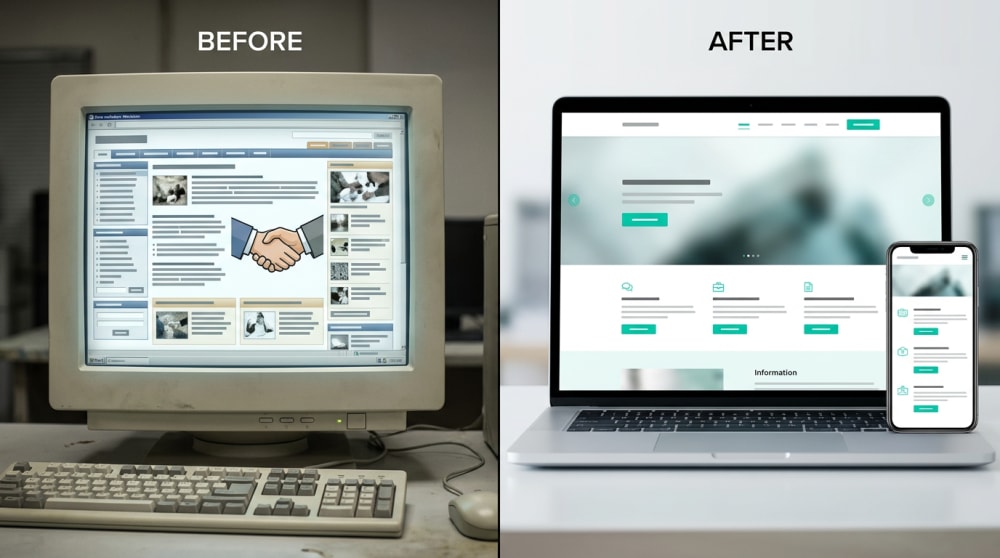
The inverse is also true. A site that looks like a 2009 template — clip-art handshake, Comic Sans headings, broken mobile layout — tells a prospect something about your attention to detail. Unfair? Maybe. But clients judge what they can see, and they can't see your working papers.
A firm identity that signals competence before a prospect reads a single word.
Build Your Firm's Visual IdentityQuestions CAs Actually Ask Us
Is it allowed for a CA firm to have a website as per ICAI?
Yes. ICAI's Website Guidelines (Code of Ethics, Volume II) expressly permit members and firms to maintain a website, provided it stays factual and runs on a pull basis. What's prohibited is solicitation — client names, fees, testimonials, superlatives and the other items in ICAI's October 2020 advisory.
How much does a CA firm website cost in India?
A simple compliant site with a custom design starts around ₹15,000; a full professional firm site with more pages, full SEO and a blog starts around ₹40,000. Portals with client logins and document handling start around ₹1,00,000. Recurring costs are modest — domain and hosting are separate yearly costs you pay to those providers, roughly ₹4,000–10,000 a year on typical shared hosting (our website cost calculator breaks it down).
Can a CA firm do SEO or run Google Ads?
SEO on your own site is pull-based — people find you when they search — and sits comfortably within the Guidelines when the content stays factual. Paid advertising of core professional services is a different matter and has traditionally fallen foul of Clause (7). Rules evolve, so check ICAI's Ethical Standards Board for current positions before spending on ads.
What should a CA website include?
Five things cover most firms: a factual home page, service descriptions, partner profiles with qualifications, a contact page with map and phone, and an articles section for professional updates. Skip testimonials, client lists and award badges — they're prohibited anyway.
The Firms That Move First Will Be the Ones Found First
Most CA firms in India still don't have a proper website. That's not a problem — it's a window. Search results for "CA in [your city]" are thin in most of the country, which means a well-built, well-written site can own that visibility for years while the rest of the profession debates whether it's necessary. Your next client is already searching. The only question is whose name comes up.
Twenty minutes with us, and you'll know exactly what your firm's website should be — and what it'll cost.
Book a Free 20-Minute Call

Comments0